
Defending Your Attention in the Attention Economy
Why what you focus on is quietly shaping who you become
We live in what is often called the attention economy—a world where your attention is not just valuable, but actively competed for, tracked, engineered, and sold.
This isn’t a conspiracy theory. It’s a business model.
Every scroll, click, pause, and like feeds an ecosystem designed to learn what captures you emotionally—and then serve you more of it. Not because it’s good for you. Not because it helps you grow. But because it keeps you engaged.
And the cost of this constant engagement is rarely discussed.
Attention Is Not Neutral
Most people think of attention as passive—something that just “happens” to us.
In reality, attention is creative.
What you repeatedly give your attention to becomes familiar, normalized, emotionally charged, and internally reinforced.
Over time, this shapes your beliefs about yourself, your expectations of life, your sense of what is possible for you, and your baseline emotional state.
In other words, attention programs the mind.
And much of today’s programming is outsourced.
How Attention Gets Hijacked
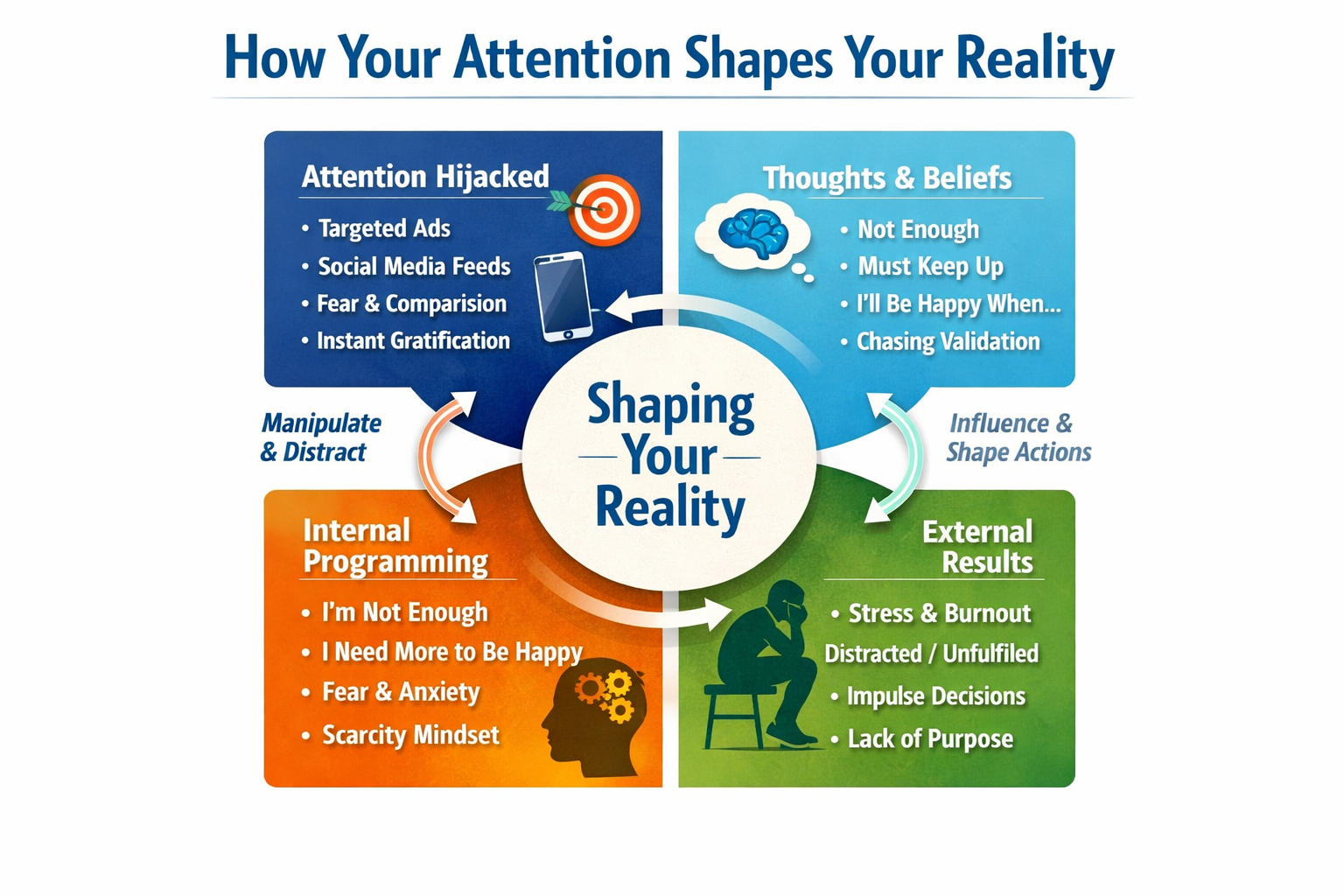
Modern platforms are not neutral tools. They are optimized systems designed to trigger emotional responses (fear, outrage, desire, comparison), keep you looping instead of reflecting, shorten attention spans while increasing dependency, and feed you content and ads based on psychological profiling. These are called psychographics rather than demographics.
Targeted advertising doesn’t just sell products—it sells narratives such as:
“You’re behind.”
“You’re not enough yet.”
“You need this to be happy.”
“Everyone else has figured it out.”
These messages quietly install beliefs—often without our conscious consent.
Over time, we begin to confuse marketing narratives with personal truth.
Internal Programming Shapes External Results
Here’s the part most people miss:
Your internal world determines how you show up in the external one…so if your “attention diet” is filled with constant comparison, fear-based headlines, highlight reels of other people’s lives, and artificial urgency/scarcity…then your nervous system, self-talk, and decision-making will reflect that.
This may feel like being more distracted/less grounded, feeling busier yet less fulfilled, being motivated by anxiety vs purpose, and being totally disconnected from your own intuition.
It's important to mention this is NOT because something is “wrong” with you—but because your attention has been continuously pulled away from what actually matters.
The Subtle Trade We’re Making
The real danger of the attention economy isn’t that it steals time. It’s that it replaces intentional living with reactive living.
When attention is fragmented and under assault reflection disappears, meaning in life gets drowned out, our values become blurry, and our long-term vision gives way to constant short term stimulation.
We slowly trade ownership of our inner life for convenience and entertainment.
And most of us never consciously chose that trade.
Defending Your Attention Is an Act of Self-Leadership
Defending your attention doesn’t mean rejecting technology or living off-grid.
It means:
Becoming aware of what you consume
Asking who benefits from your attention
Choosing inputs that align with who you want to become
Creating space for stillness, reflection, and intention
This is not about willpower—it’s about environment design.
Just as you’d be thoughtful about what you eat if you cared about your physical health, you must be thoughtful about what you consume mentally if you care about your identity, confidence, and direction.
Reclaiming Attention Starts With Awareness
The moment you realize your attention is being monetized, your beliefs are influenced by repeated exposure, and your inner narrative is not entirely self-generate…is the moment you regain leverage.
From there, you can begin to choose what inputs you want, reduce the noise around you, create intentional boundaries, and reconnect with your own values, goals, and intuition.
A Question Worth Sitting With
If your attention truly shapes your life…
Who—or what—are you currently allowing to shape yours?
And just as importantly:
Is it aligned with the life you actually want to live?